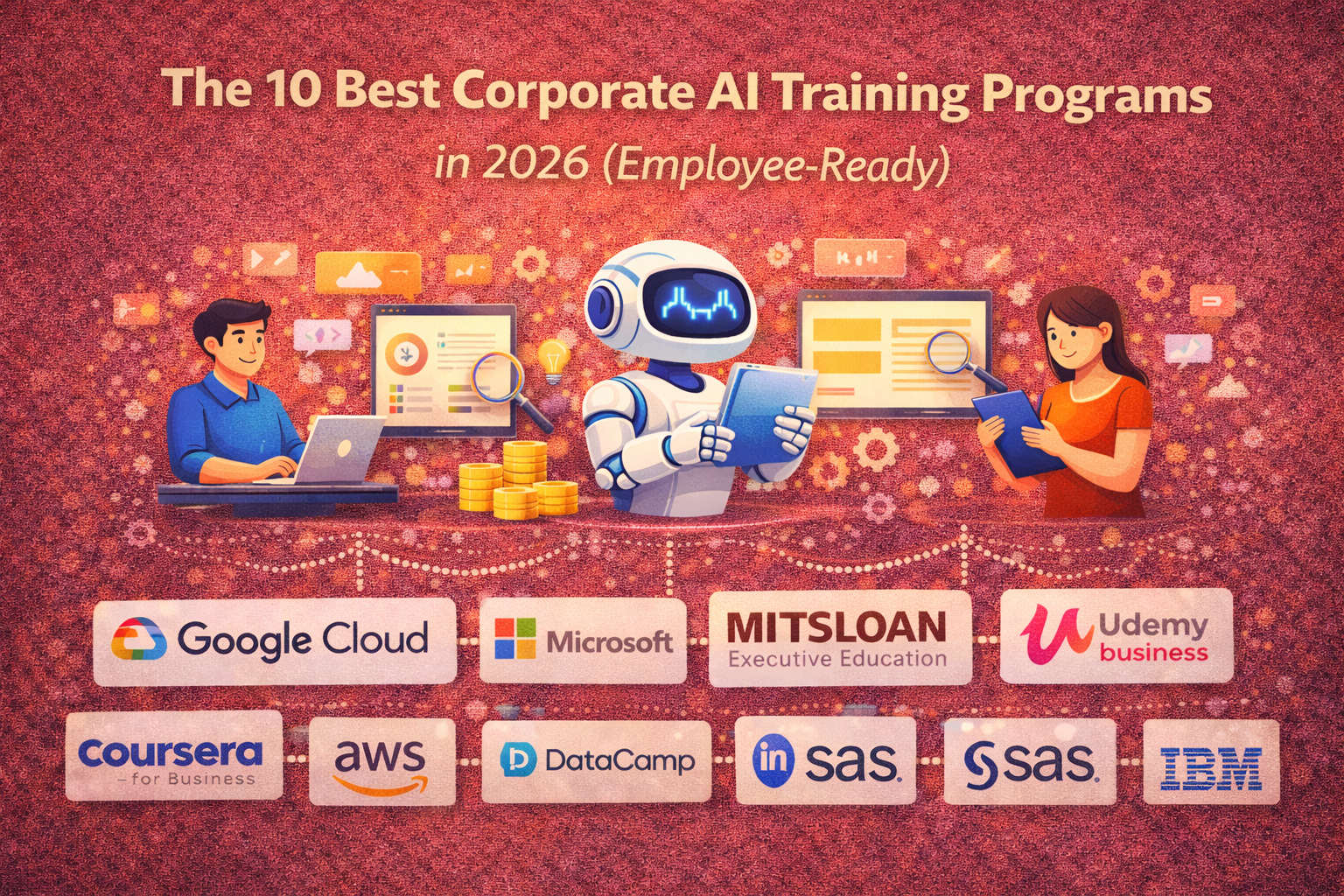
The 10 Best Corporate AI Training Programs in 2026 (Employee-Ready)
Compare the 10 best corporate AI training programs for 2026 — from Udemy Business and Coursera to free options like IBM Skills Build. Find the right fit for your team's skills, goals, and budget.

Disclosure: This post contains affiliate links. If you enroll or purchase through them, we may
earn a commission at no extra cost to you. We only recommend programs we believe deliver real value to teams.
Read our full Affiliate & Earnings Disclaimer.
The AI revolution is already reshaping how teams work — and the real question in 2026 isn’t whether to adopt AI, but how fast you can equip employees to use it responsibly and effectively. This guide cuts through the noise with the 10 best corporate AI training programs, each evaluated on content quality, enterprise features, scalability, value, and learner support — so you can find the right fit for your workforce and budget.
⭐ Our Top Picks at a Glance
Short on time? Start with these three.
Best Overall
View Program
Udemy Business — AI Learning Bundle
800+ courses and flexible, self-paced learning for diverse teams
Best for Enterprise
View Program
Correlation One
Fully customized generative-AI training aligned to your business goals
Best Budget
View Program
IBM SkillsBuild
Free, job-ready AI training with IBM-recognized credentials
Why Corporate AI Training Matters in 2026
The business case for corporate AI training has never been stronger. As AI tools become embedded in every part of work — content, analysis, customer service, strategy — employees who can use them effectively become invaluable. Organizations that delay risk falling behind competitors who’ve already built AI-literate teams.
The Business Case for AI Education
The ROI extends well beyond individual productivity. Companies with AI-trained workforces report better decision-making, faster innovation, stronger retention, and improved competitive positioning. Responsible AI use is also now a board-level concern: as regulation tightens, untrained AI use exposes companies to real reputational and legal risk. Programs that build in responsible-AI principles help mitigate that while building trust.
What Every Employee Needs to Know
Different roles need different levels of proficiency. Every employee should understand what AI is, how it works conceptually, and how to interact with it responsibly — a shared foundation that lets everyone participate. Beyond that, people need practical, role-relevant skills: marketers mastering AI content creation, analysts using AI-driven analytics, managers learning to evaluate AI recommendations critically. The best programs offer role-based paths.
Key Features of Employee-Ready Programs
Look for comprehensive content spanning fundamentals, practical application, and ethics; accessibility for non-technical staff alongside advanced tracks; and enterprise-ready features like admin dashboards, LMS integration, progress analytics, and scalable pricing. Above all, favor hands-on learning over passive consumption — AI skills develop through practice.
The 10 Best Corporate AI Training Programs for 2026
Each entry below includes an overview, pricing, pros and cons, and who it’s best for.
1. Udemy Business — AI Learning Bundle
Best OverallOne of the most comprehensive solutions available, with 800+ AI courses from foundations to advanced implementation. Its scale and variety let employees learn at their own pace and explore what’s relevant to their role — ideal for diverse workforces with varying skill levels.
Pricing: Per-seat, volume discounts available. Contact Udemy for enterprise quotes.
Pros
- Massive library covering nearly every AI topic
- Flexible self-paced learning
- Multilingual for global teams
- Strong enterprise integrations
Cons
- Quality varies by instructor
- Requires learner self-motivation
- No dedicated CSM for smaller accounts
Best for: Large enterprises with diverse needs wanting flexibility and learner choice.
Visit Udemy Business →2. Correlation One — Generative AI Training
Best Custom EnterpriseA leader in enterprise AI training, offering customized generative-AI programs tailored to specific business objectives rather than generic content. Their consultative approach designs training around your challenges and measures real outcomes.
Pricing: Custom, based on scope. Contact for enterprise quotes.
Pros
- Highly customized to your needs
- Strong ROI/outcomes focus
- Expert, experienced instructors
- Support across the journey
Cons
- Premium pricing
- Needs organizational commitment
- Not for quick deployments
Best for: Enterprises with specific transformation goals and change-management budget.
Visit Correlation One →3. Go1 — AI Training Solutions
Best Content VarietyA leading aggregator with 2,500+ AI courses from multiple providers on one unified platform, notable for role-based pathways. Continuous curation keeps content current and takes the sourcing burden off internal L&D teams.
Pricing: Per-seat enterprise pricing. Contact for quotes.
Pros
- Huge library via one platform
- Role-based pathways simplify design
- Quality curation reduces evaluation
- Strong analytics
Cons
- Large selection can overwhelm
- Quality still varies by provider
- Navigation learning curve
Best for: Organizations wanting variety without sourcing complexity.
Visit Go1 →4. Microsoft — Responsible AI Training
Best for EthicsThe gold standard for building ethical AI capabilities, built around six principles: fairness, reliability and safety, privacy and security, inclusiveness, transparency, and accountability — a framework you can adopt regardless of which AI tools you use.
Pricing: Much is free via Microsoft Learn; enterprise programs via licensing.
Pros
- World-class expertise
- Comprehensive responsible-AI framework
- Free foundational content
- Recognized credentials
Cons
- Focused on responsible AI, not broad training
- Implementation tracks are technical
- Tied to Microsoft ecosystem in places
Best for: Organizations prioritizing ethical AI, especially Microsoft-stack companies.
Visit Microsoft Learn →5. Coursera for Business
Best CredentialsUniversity-backed education for corporate teams, with courses and professional certificates from Google, IBM, Stanford and other top institutions. Employees learn AI skills and earn credentials that carry real professional weight.
Pricing: Subscription, varies by features/seats. Financial aid options available.
Pros
- University-quality content + credentials
- Strong job-market recognition
- Diverse top institutions
- Comprehensive pathways
Cons
- Subscription costs accumulate
- Academic format feels less practical to some
- Less org-specific
Best for: Companies valuing academic rigor and credentials to attract/retain talent.
Visit Coursera for Business →6. LinkedIn Learning — AI Learning Paths
Best for ProfessionalsAn extensive AI library integrated with the world’s largest professional network. Structured paths take employees from fundamentals to application, and completed certifications display directly on LinkedIn profiles — adding motivation and employer-branding value.
Pricing: Via LinkedIn Premium (~$30/mo per user); enterprise rates available.
Pros
- Seamless LinkedIn integration
- Professional-focused content
- Short format suits busy staff
- Mobile-friendly
Cons
- Requires LinkedIn Premium
- Less comprehensive than dedicated platforms
- Less hands-on project focus
Best for: Organizations emphasizing professional development and recruiter-visible credentials.
Visit LinkedIn Learning →7. IBM SkillsBuild
Best Free OptionA major commitment to democratizing AI education: free, comprehensive, job-ready training. The curriculum emphasizes practical, job-relevant skills over theory, reflecting IBM’s long history in enterprise technology.
Pricing: Many programs free; some premium features/certs may have costs.
Pros
- Free, high-quality education
- Strong job-readiness focus
- IBM credentials carry weight
- Globally accessible
Cons
- Less tailored to specific enterprises
- Support varies by program
- Limited advanced technical content
Best for: Cost-conscious organizations wanting free, IBM-recognized training.
Visit IBM SkillsBuild →8. Lead with AI — Enterprise Training
Best for AdoptionPurpose-built to train every employee regardless of technical background, with role-based training and a strong adoption focus. Hands-on assignments build directly applicable skills, and regular updates keep pace with new AI capabilities.
Pricing: Enterprise pricing by size/requirements. Contact for quotes.
Pros
- Built for company-wide deployment
- Role-based relevance
- Adoption focus = immediate value
- Regular content updates
Cons
- Newer, less established track record
- May be premium for small orgs
- Less library breadth
Best for: Organizations prioritizing practical, company-wide implementation.
Visit Lead with AI →9. Traliant — AI Ethics Training
Best for ComplianceFocused specifically on AI ethics and responsible use, with interactive, scenario-based modules that address growing regulatory and reputational risk. A compliance-ready approach that engages learners while protecting the organization.
Pricing: Enterprise pricing by size/scope. Contact for quotes.
Pros
- Specialized ethics focus
- Interactive, engaging format
- Compliance-ready curriculum
- Reduces organizational risk
Cons
- Narrow focus on ethics
- Needs technical supplementation
- Not a standalone comprehensive program
Best for: Regulated industries and companies building responsible-AI cultures.
Visit Traliant →10. MinnaLearn — AI Literacy for Employees
Best for Baseline LiteracyBrings the globally recognized Elements of AI approach to the enterprise, having already educated millions. Efficient, digestible modules build understanding without adding workload — ideal for baseline literacy across large workforces.
Pricing: Enterprise pricing; many resources free for individuals.
Pros
- Proven curriculum, millions of learners
- Lightweight and efficient
- Low time commitment
- Builds foundations well
Cons
- Less comprehensive than full platforms
- Needs supplementation for technical roles
- Limited advanced content
Best for: Organizations wanting proven, lightweight baseline AI literacy for everyone.
Visit MinnaLearn →Feature Comparison Table
| Program | AI Fundamentals | Ethics / Responsible AI | Data Literacy | Role-Based Tracks | Enterprise Support | Pricing |
|---|---|---|---|---|---|---|
| Udemy Business | ✓ | Limited | ✓ | ✓ | ✓ | Per seat |
| Correlation One | ✓ | ✓ | ✓ | ✓ | ✓ | Custom |
| Go1 | ✓ | ✓ | ✓ | ✓ | ✓ | Per seat |
| Microsoft | Limited | ✓ | Limited | ✓ | ✓ | Free/Premium |
| Coursera for Business | ✓ | ✓ | ✓ | ✓ | ✓ | Subscription |
| LinkedIn Learning | ✓ | Limited | ✓ | ✓ | ✓ | Premium |
| IBM SkillsBuild | ✓ | ✓ | ✓ | Limited | ✓ | Free |
| Lead with AI | ✓ | ✓ | ✓ | ✓ | ✓ | Enterprise |
| Traliant | Limited | ✓ | Limited | Limited | ✓ | Enterprise |
| MinnaLearn | ✓ | ✓ | ✓ | Limited | ✓ | Enterprise |
Which Corporate AI Training Program Is Right for Your Organization?
Best for Comprehensive Learning: Udemy Business or Go1
For the broadest content access and maximum flexibility — thousands of courses, role-based pathways, and freedom for employees to learn what applies to their positions.
Best for Custom Enterprise Solutions: Correlation One or Lead with AI
For highly customized programs aligned to specific business objectives. More investment, but they deliver precisely what your organization needs.
Best for Responsible AI Focus: Microsoft or Traliant
For organizations prioritizing ethical AI practices — specialized solutions that build critical capabilities and reduce risk.
Best Budget Option: IBM SkillsBuild or MinnaLearn
For cost-effective, foundational AI literacy — valuable free or low-cost options that scale across large teams.
Frequently Asked Questions
How much does corporate AI training cost?
It varies widely by program type, org size, and scope — from free (IBM SkillsBuild, Microsoft Learn) to several hundred dollars per employee for comprehensive enterprise solutions.
How long does employee AI training take?
Basic AI literacy can be achieved in 2–8 hours through lightweight programs. Comprehensive, job-ready training typically takes 2–6 months of ongoing learning.
Do employees need technical backgrounds for AI training?
No — employee-ready programs are designed for non-technical learners. Options like MinnaLearn and Traliant require no prior technical knowledge.
How do we measure training ROI?
Choose programs with analytics dashboards tracking completion, assessment scores, and skill application. The best enterprise solutions provide clear metrics tying training to productivity gains.
The Bottom Line
Corporate AI training has shifted from optional enhancement to strategic necessity. For most organizations, we recommend starting with a comprehensive platform like Udemy Business or Go1 for flexibility, then layering in specialized ethics training from Microsoft or Traliant. Whichever you choose, the most important step is starting — AI capabilities compound, and teams that build them today reap advantages for years.
Ready to build an AI-ready team?
Start with our top overall pick and roll out training your whole workforce can actually use.
Explore Udemy Business →