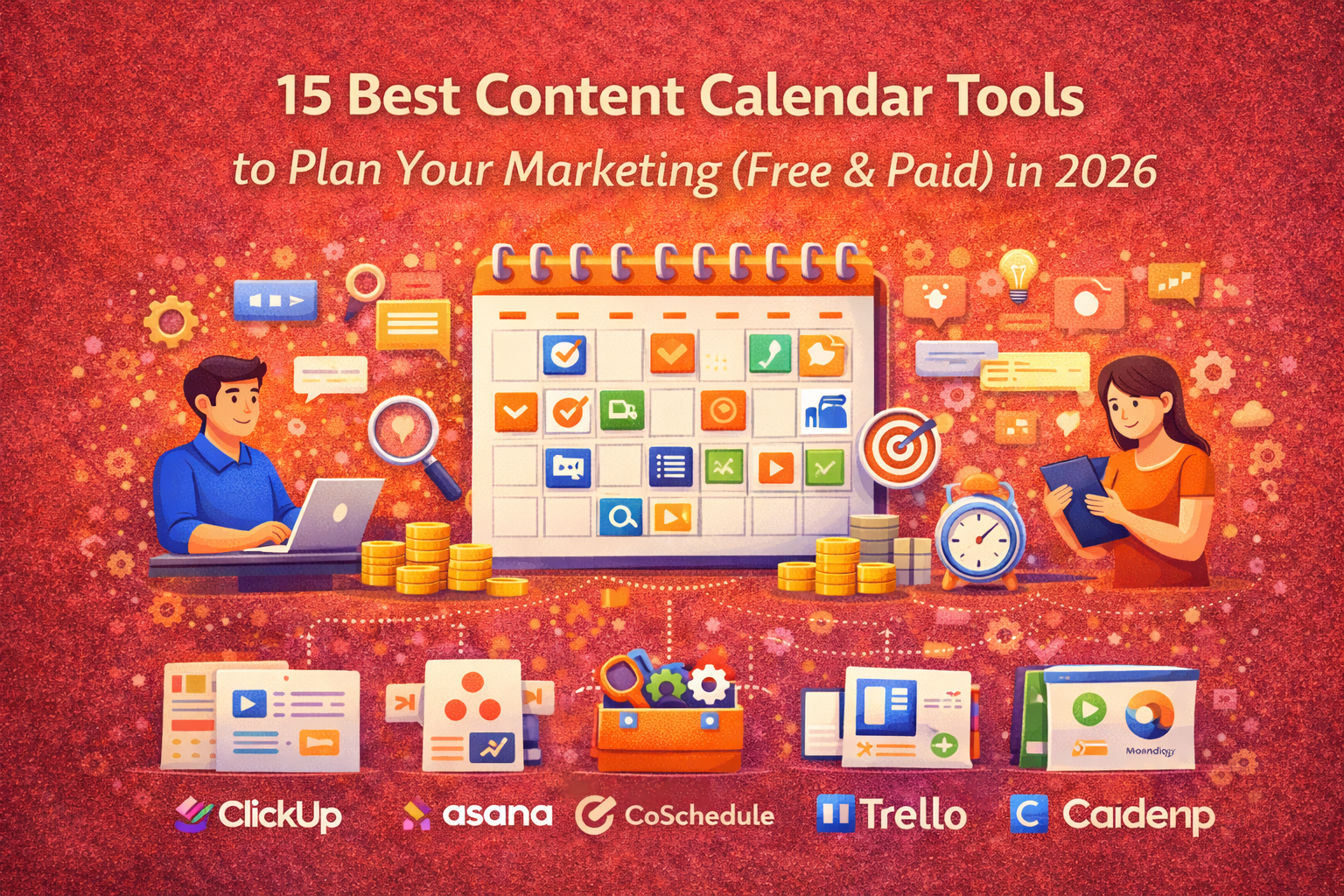
15 Best Content Calendar Tools to Plan Your Marketing (Free & Paid) in 2026
Compare the 15 best content calendar tools for 2026 — free and paid, from Notion and Trello to CoSchedule, Planable, and Sprout Social. Find the right fit for your team size and budget.

Disclosure: This post contains affiliate links. If you sign up through them, we may earn a
commission at no extra cost to you. We only recommend tools we believe help teams publish consistently.
Read our full Affiliate & Earnings Disclaimer.
Related reading: See content marketing tools for small teams, how to create a content marketing strategy, and the 15 best digital marketing tools.
Scattered ideas, missed deadlines, duplicated effort, and the daily “what should we post today?” scramble — that’s life without a content calendar. The right tool turns that chaos into clarity, giving your team visibility, consistency, and alignment. But with dozens of options from free to enterprise, which is right for you? This guide reviews the 15 best content calendar tools for 2026 — free and paid, for every budget and team size — so you can finally take control of your publishing schedule.
⭐ Our Top Picks at a Glance
Short on time? Start with these three.
What to Look For in a Content Calendar Tool
Every effective content calendar should offer a calendar view, multiple views (list, board, timeline), real-time collaboration, status tracking, due dates and reminders, filtering and search, and mobile access. Depending on your team, valuable extras include publishing integration, approval workflows, an asset library, analytics, client workspaces, template libraries, and AI assistance. Before choosing, ask: how big is my team, do I need direct publishing, do I need client approvals, and what’s my budget?
Quick Comparison: All 15 Content Calendar Tools
| Tool | Price | Free Plan | Publishing | Best For |
|---|---|---|---|---|
| Notion | Free–$10/mo | Yes | No | All-in-one flexibility |
| Google Sheets | Free | Yes | No | Simplicity, budget |
| Trello | Free–$5/mo | Yes | No | Visual kanban |
| ClickUp | Free–$7/mo | Yes | No | Feature-rich free |
| Airtable | Free–$20/mo | Yes | No | Database calendars |
| CoSchedule | $29/mo | No | Yes | Marketing teams |
| Monday.com | $9/seat/mo | Yes | No | Visual teams |
| Asana | Free–$11/mo | Yes | No | Workflow management |
| Loomly | $32/mo | No | Yes | Social media teams |
| Planable | Free–$33/mo | Yes | Yes | Approval workflows |
| Sprout Social | $249/mo | No | Yes | Enterprise social |
| Adobe Express | Free–$10/mo | Yes | Yes | Design + calendar |
| Wrike | Free–$10/mo | Yes | No | Complex workflows |
| Kapost | Custom | No | Yes | B2B content ops |
| Percolate | Custom | No | Yes | Enterprise marketing |
Best Free Content Calendar Tools
1. Notion
Best Free All-in-OneThe go-to workspace for content teams wanting flexibility and power for free. Switch between calendar, table, kanban, timeline, and gallery views; combine your calendar with briefs, style guides, and SOPs; and tap a built-in AI assistant for ideation.
Pricing: Free; Plus $10/user/mo. Free plan: unlimited pages, generous limits.
Pros
- Incredibly flexible
- Generous free tier
- Calendar + docs in one
Cons
- Learning curve
- No built-in social publishing
Best for: Teams wanting an all-in-one workspace with maximum flexibility.
Try Notion Free →2. Google Sheets
Best for SimplicitySometimes the simplest solution wins. A familiar interface anyone can use immediately, with real-time collaboration, custom formulas, conditional formatting for status color-coding, and version history — all free.
Pricing: Free (Google Workspace from $6/user/mo). Full functionality, 15GB storage.
Pros
- Completely free
- Everyone knows it
- Highly customizable
Cons
- No calendar visualization
- Manual setup; no publishing
Best for: Budget-conscious teams and individuals wanting a familiar, free tool.
Open Google Sheets →3. Trello
Best Free KanbanVisual kanban boards make content planning intuitive and even fun. Drag cards through workflow stages, add the Calendar power-up to view due dates as a calendar, and automate repetitive actions with Butler.
Pricing: Free; Standard $5/user/mo. Free: unlimited cards, 10 boards.
Pros
- Extremely intuitive
- Quick to set up
- Excellent mobile app
Cons
- Calendar needs a power-up
- Limited reporting; no publishing
Best for: Visual thinkers and small teams who like watching content move through stages.
Try Trello Free →4. ClickUp
Most Free FeaturesPacks more into its free tier than most paid tools: calendar, list, board, Gantt, and timeline views, custom fields, built-in docs, goals, time tracking, automations, and 1,000+ integrations.
Pricing: Free; Unlimited $7/user/mo. Free: unlimited tasks and members.
Pros
- Most features of any free tool
- Highly customizable
- Strong automation
Cons
- Can overwhelm; steep learning curve
- Interface can feel cluttered
Best for: Teams wanting enterprise-level features without paying.
Try ClickUp Free →5. Airtable
Best Database CalendarCombines spreadsheet familiarity with database power. Grid, calendar, kanban, gallery, and timeline views; linked records connecting content to campaigns, authors, and channels; forms to collect requests; and automations.
Pricing: Free; Team $20/user/mo. Free: 1,000 records per base, 1GB attachments.
Pros
- Powerful relational database
- Beautiful calendar views
- Great for complex workflows
Cons
- 1,000-record free limit
- Complex setup; no publishing
Best for: Data-driven marketers wanting spreadsheet familiarity with database power.
Try Airtable Free →Best Paid Content Calendar Tools
6. CoSchedule
Best for MarketersBuilt specifically for marketers, combining a drag-and-drop calendar with social publishing and content optimization. ReQueue reshares top content, the headline analyzer boosts engagement, and the WordPress integration runs deep.
Pricing: From $29/mo (Marketing Calendar); 14-day free trial.
Pros
- Purpose-built for marketers
- Integrated social publishing
- Excellent WordPress integration
Cons
- No free plan
- Social features need higher tiers
Best for: Marketing teams, especially WordPress users.
Try CoSchedule →7. Monday.com
Best for Visual TeamsStunning visual boards and dashboards make content planning a pleasure. Timeline, calendar, kanban, and Gantt views; real-time status dashboards; content briefs in Workdocs; and guest access to invite clients without full licenses.
Pricing: Basic $9/seat/mo; free for 2 users.
Pros
- Beautiful, intuitive interface
- Excellent client management
- Strong automation
Cons
- Per-seat pricing adds up
- No built-in publishing
Best for: Visual teams and agencies managing client content.
Try Monday.com →8. Asana
Best for WorkflowsExcels at complex content workflows with task dependencies and automation. List, board, calendar, and timeline views; custom fields; a workflow builder; forms to standardize requests; and portfolios across projects.
Pricing: Free; Premium $10.99/user/mo. Free: up to 10 users.
Pros
- Excellent task management
- Strong free tier (10 users)
- Great for complex workflows
Cons
- Calendar less visual
- Task-focused vs content-focused
Best for: Teams with complex workflows needing dependencies and approvals.
Try Asana Free →9. Loomly
Best for Social TeamsPurpose-built for social content, combining calendar planning with direct publishing. AI-powered post ideas, auto-publishing to all major platforms, multi-level approval workflows, an asset library, and analytics.
Pricing: From $32/mo (Base, 2 users); 15-day free trial.
Pros
- Purpose-built for social
- Integrated publishing
- Content inspiration features
Cons
- Social-only focus
- Per-calendar pricing
Best for: Social media teams and agencies focused on social content.
Try Loomly →10. Planable
Best for ApprovalsExcels at collaboration and approval workflows, showing exact post previews before publishing. Real-time co-editing, multi-level internal and client approvals, direct social publishing, and separate client workspaces.
Pricing: Free (50 posts); Pro $33/user/mo.
Pros
- Best-in-class approvals
- Exact platform previews
- Excellent for agencies
Cons
- Free plan very limited
- Social-focused; limited analytics
Best for: Agencies and teams needing robust approval workflows.
Try Planable Free →Best Enterprise Content Calendar Tools
11. Sprout Social
Best Enterprise SocialComprehensive social media management for enterprise teams: a unified cross-platform calendar, publishing at scale, social listening, advanced analytics, a social CRM, and enterprise-grade approval workflows.
Pricing: From $249/mo (Standard); 30-day free trial.
Pros
- Comprehensive social suite
- Excellent analytics + listening
- Strong enterprise features
Cons
- Very expensive
- Social-only; per-user pricing
Best for: Enterprise social teams needing management, listening, and analytics.
Try Sprout Social →12. Adobe Express (ContentCal)
Best for Brand DesignCombines design tools with content calendar functionality for brand consistency. Plan and schedule content, create graphics in-platform, maintain a brand kit, publish to social, and tap thousands of branded templates plus Creative Cloud integration.
Pricing: Free; Premium $9.99/mo.
Pros
- Design + calendar combined
- Brand management built-in
- Adobe ecosystem integration
Cons
- Calendar features less robust
- Design-focused; still evolving
Best for: Design-forward teams, especially existing Adobe users.
Try Adobe Express →13. Wrike
Best Complex Marketing OpsEnterprise-grade project management with robust content calendar capabilities: calendar view, custom approval workflows, resource management, visual proofing, time tracking, advanced reporting, and 400+ integrations.
Pricing: Free; Professional $9.80/user/mo. Free: up to 5 users.
Pros
- Enterprise-grade features
- Strong workflows + resourcing
- Advanced reporting
Cons
- Complex for simple needs
- No publishing; dated interface
Best for: Large marketing teams with complex workflows.
Try Wrike Free →14. Kapost (Upland)
Best B2B Content OpsFull content operations management from planning through distribution. An editorial calendar across channels, complex production workflows, multi-channel distribution, content analytics, sales enablement, and persona targeting.
Pricing: Custom (enterprise); demo available.
Pros
- Built for B2B content
- Full content operations
- Sales alignment + deep analytics
Cons
- Enterprise pricing only
- Complex implementation
Best for: B2B enterprise teams needing full content operations.
Explore Kapost →15. Percolate (Seismic)
Best Enterprise MarketingComplete marketing orchestration for global enterprise teams: an enterprise content calendar, campaign management, production at scale, centralized digital asset management, global brand compliance, and multi-region coordination.
Pricing: Custom (enterprise); demo available.
Pros
- True enterprise scale
- Brand governance
- Global team support
Cons
- Enterprise pricing
- Long, complex implementation
Best for: Large enterprises needing full marketing orchestration at scale.
Explore Percolate →Content Calendar Tools by Use Case
| Use Case | Top Pick | Runner-Up | Third |
|---|---|---|---|
| Solopreneurs | Notion (free) | Google Sheets | Trello |
| Small teams (2–10) | ClickUp | Asana | Monday.com |
| Agencies | Planable | Monday.com | Loomly |
| Enterprise | Sprout Social | Wrike | Percolate |
| Social media focus | Loomly | Planable | CoSchedule |
How to Set Up Your Content Calendar
Whichever tool you choose, follow these steps for an effective calendar.
Step 1: Define Your Content Types
List every format you’ll track — blog posts, social posts, email newsletters, videos, podcasts, case studies — with frequency and primary channel for each.
Step 2: Set Your Publishing Cadence
Create a weekly schedule you can actually maintain. Consistency beats volume — start with a cadence you can sustain and build from there.
Step 3: Create Your Calendar Structure
Include these essential fields: publish date, content type, title/topic, status, owner, channel, target keyword, and campaign. This covers planning through SEO and reporting.
Step 4: Build Your Workflow
Define clear status stages so nothing stalls: Idea → Brief Ready → In Progress → In Review → Approved → Scheduled → Published → Promote.
Template shortcut: Color-code by content type (blog = blue, social = purple, email = green, video = red, podcast = orange), and add automations like “publish date = today → mark Published → add to promotion queue.”
Frequently Asked Questions
What is the best free content calendar tool?
Notion is the best free option for most users — unlimited pages, flexible views including a calendar, and docs combined with planning. For maximum features, ClickUp offers the most in its free tier.
How do I choose between free and paid options?
Go free if you’re a solo or small team (under 5), don’t need direct publishing, and want to minimize cost. Go paid for social publishing, approval workflows, advanced analytics, client management, or enterprise security. Most teams start free and upgrade as they grow.
Can I use a content calendar for social media?
Yes. Many tools handle social planning, but if social is your primary focus, choose one with built-in publishing like Loomly, Planable, or CoSchedule so you can schedule and post without switching tools.
How far ahead should I plan my content?
Plan at least 2–4 weeks ahead for consistent execution, and 1–3 months for strategic content. Leave enough runway for quality creation without planning so far out that priorities shift.
Should I use a dedicated tool or a spreadsheet?
A spreadsheet works for small teams with simple needs and tight budgets. A dedicated tool wins once you need collaboration, visual planning, automation, or publishing integration — most growing teams outgrow spreadsheets.
Choosing Your Content Calendar Tool
The right tool turns chaotic content creation into a systematic process. If you’re unsure where to start, begin with Notion (free) or Trello (free) — both are easy to set up and will reveal what features you actually need. After 2–3 months you’ll have clear requirements to justify a more specialized tool like CoSchedule for marketing or Planable for client approvals. The best tool is the one your team will actually use consistently.
Ready to end your content chaos?
Pick a tool, set up your calendar, and start publishing consistently this week.
Start Free with Notion →