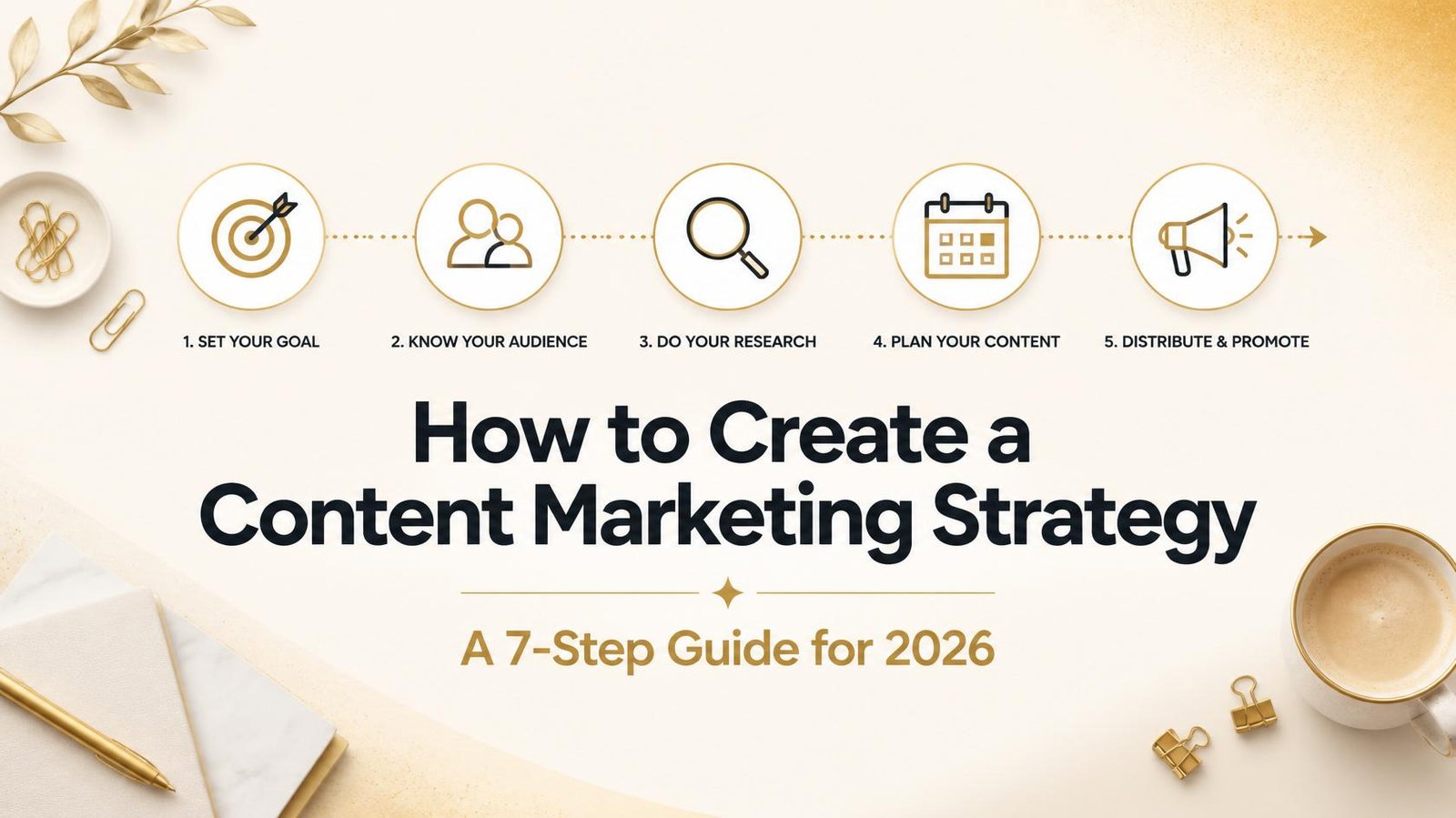
How to Create a Content Marketing Strategy in 2026 (7-Step Guide)
Most content fails because there was no strategy behind it. Here's how to build one in seven steps — goals, audience, keywords, formats, calendar, and the distribution half everyone skips.

Disclosure: This post contains affiliate links. If you sign up through them, we may earn a
commission at no extra cost to you. We only recommend tools we’d actually use ourselves.
Read our full Affiliate & Earnings Disclaimer.
Most content fails for one boring reason: there was no strategy behind it. Someone publishes a post because it’s Tuesday, picks a topic that feels relevant, hits publish, and hopes. Six months and forty posts later, the traffic is flat and nobody can say why. The problem was never the writing. It was the absence of a plan connecting each piece to an actual business goal.
A content marketing strategy is that plan. It’s the difference between publishing content and building an asset — a system where every piece has a job, a target reader, a keyword, and a path to bringing you traffic or customers. This guide walks through building one from scratch in seven steps, written for solopreneurs and small teams who don’t have a marketing department to lean on.
Key Takeaways
- Strategy before publishing. A documented plan is the single biggest predictor of content that actually works.
- Goals drive everything — every piece of content should trace back to a specific, measurable objective.
- Write for one reader. Content aimed at everyone resonates with no one.
- Keywords + intent decide what to create; guessing wastes months.
- Distribution is half the job. Publishing isn’t the finish line — it’s the halfway point.
Related reading: See content marketing tools for small teams, the best content calendar tools, and the 15 best digital marketing tools.
What a Content Marketing Strategy Actually Is
A content marketing strategy is a documented plan for what you’ll create, who it’s for, why it exists, and how it will reach people and drive results. The key word is documented. A strategy living in your head isn’t a strategy — it’s an intention, and intentions drift.
The distinction that matters: a strategy is the why and the who (your goals, your audience, your positioning). A plan is the what and when (your calendar and topics). Most people jump straight to the plan — “I’ll post twice a week” — without the strategy underneath it, which is why their content feels random. This guide builds both, in order.
Why documented strategies win: writing it down forces the hard decisions — who you’re
not targeting, what you won’t cover, which goal takes priority. Those constraints are what make content
focused enough to work. A vague plan produces vague content.
Step 1: Define Your Goals & KPIs
1
Decide what content is actually for
Before a single word gets written, answer one question: what is this content supposed to do? “Get more traffic” isn’t specific enough. Content can serve very different goals, and the goal changes what you create.
Common content goals
- Brand awareness — reach people who’ve never heard of you (top-of-funnel, broad topics)
- Traffic — rank in search and bring visitors (SEO-driven, keyword-targeted)
- Lead generation — capture emails and build a list (gated content, lead magnets)
- Sales / affiliate revenue — drive purchases (comparison posts, reviews, buying guides)
- Authority — become the trusted name in your niche (deep, original, expert content)
Most solopreneurs need a mix, but one goal should lead. If affiliate revenue is the priority, your strategy weights toward comparison and review content with commercial intent. If it’s audience-building, you weight toward helpful top-of-funnel guides. Pick the lead goal now — it shapes every later step.
Turn goals into KPIs
A goal without a number is a wish. Attach a measurable KPI and a timeframe to each:
| Goal | KPI to track |
|---|---|
| Awareness | Impressions, reach, new visitors |
| Traffic | Organic sessions, keyword rankings |
| Leads | Email signups, conversion rate |
| Sales | Affiliate clicks, revenue, conversion rate |
| Authority | Backlinks, returning visitors, brand searches |
Be realistic about timelines. SEO-driven traffic goals take 3–6 months to show movement.
Set quarterly KPIs, not weekly ones, or you’ll declare failure before the strategy has had a chance to work.
Step 2: Know Your Audience
2
Write for one person, not everyone
The most common content mistake is writing for “anyone who might be interested.” Content aimed at everyone connects with no one. The fix is to define a specific reader and write every piece as if it’s for them.
Build a simple audience profile
You don’t need a formal persona document. Answer these plainly:
- Who are they? Role, situation, stage of business or life
- What problem brings them to you? The specific pain they’re trying to solve
- What do they already know? Beginner, intermediate, or advanced — this sets your depth and tone
- Where do they hang out? Which platforms and communities they use
- What words do they use? How they describe their problem in their own language
That last point is the bridge to Step 4. The words your audience uses to describe their problem are the keywords you’ll target. You’re not guessing what to write — you’re answering questions they’re already asking.
Where to find their real language: read the comments on competitor content, browse relevant
subreddits and forums, and look at the “People also ask” boxes in Google. That’s your audience describing their
problems in their own words — free research most people skip.
Step 3: Audit What You Already Have
3
Fix and repurpose before you create
If you’ve published anything already, don’t start from a blank page — start from an audit. It’s faster to improve an existing post that’s almost ranking than to write a new one from scratch, and it tells you what’s already working.
What to look at
- Top performers — which posts already bring traffic? Make more like them.
- Nearly-there posts — anything ranking on page two of Google can often be pushed to page one with an update.
- Dead weight — thin, outdated, or off-topic posts that may be dragging your site down. Update, merge, or remove them.
- Content gaps — topics your audience needs that you haven’t covered.
- Internal linking — are your posts linking to each other, or sitting isolated?
A rank-tracking tool makes this far easier — SE Ranking shows which keywords you already rank for and where you sit, so you can spot the page-two posts worth improving. A larger all-in-one platform like Semrush adds competitor gap analysis if you want to see what rivals rank for that you don’t.
The quiet win: updating and improving existing content often produces faster results than
publishing new posts, because those pages already have some age and authority with Google. Audit first, create second.
Step 4: Research Topics & Keywords
4
Create what people search for
This is where strategy becomes concrete. Instead of guessing topics, you find what your audience actually searches for, then create content that answers it better than what’s ranking. Two things matter for every keyword: volume (how many people search it) and intent (what they want when they do).
Understand search intent
- Informational — “how to create a content strategy” (they want to learn → guides, tutorials)
- Commercial — “best email marketing tools” (they’re comparing → reviews, comparisons — where affiliate content earns)
- Transactional — “Klaviyo pricing” (ready to act → product pages, deals)
- Navigational — “Canva login” (looking for a specific site)
Match your content to intent. A buying-guide targeting an informational keyword won’t convert; a thin definition targeting a commercial keyword won’t rank. If revenue is your lead goal, weight toward commercial-intent keywords — that’s where comparison and review content earns.
How to find keywords
Start with a seed topic and expand it. A dedicated tool like SE Ranking or Semrush gives you volume, difficulty, and related terms. On a budget, Google’s own autocomplete, “People also ask,” and “Related searches” are free goldmines. The goal is a list of specific, winnable keywords — not the highest-volume terms (too competitive), but the ones where you can realistically rank.
Chase winnable keywords, not vanity ones. A term with 500 searches a month you can actually
rank for beats one with 50,000 you’ll never crack. Long, specific phrases (“content strategy for solopreneurs”) convert
better and rank easier than broad ones (“marketing”). For more on how search itself is changing, see our
guide to SEO, GEO, and AEO.
Step 5: Choose Formats & Channels
5
Match the format to the message and the platform
Not every idea belongs in a blog post. Part of strategy is deciding which format serves each topic and which channels are worth your limited time.
Content formats
- Blog posts / guides — the SEO foundation; owned, searchable, permanent
- Video — high engagement, strong on social and YouTube
- Visual / infographics — shareable, ideal for Pinterest
- Email — the channel you own outright, best for nurturing
- Social posts — reach and distribution, not usually discovery
Don’t spread yourself thin
The biggest trap for a solo creator is trying to be everywhere. Pick one core channel (usually your blog, for the SEO asset it builds) and one or two distribution channels that fit your audience. For a visual, product-driven audience, Pinterest often outperforms other social platforms and drives traffic in days rather than months.
Tools make multi-format work manageable without a team: Canva for graphics, Pinterest pins, and social visuals; InVideo for turning a post into a video without filming; and an AI writing assistant like Jasper for drafting and outlining faster.
The repurposing principle: create once, distribute many times. One solid blog post becomes a
video, five social posts, an email, and a batch of Pinterest pins. This is how one person produces the output of a team —
not by making more, but by reusing what they make.
Step 6: Build Your Content Calendar
6
Turn the plan into a schedule
A calendar turns good intentions into shipped content. It doesn’t need to be elaborate — a simple sheet works — but it needs to exist, because consistency is the single biggest factor in whether content marketing succeeds.
What each calendar entry needs
- Topic / working title
- Target keyword and its intent
- Format (post, video, etc.)
- The goal it serves (from Step 1)
- Publish date
- Status (idea → drafting → editing → published)
- Distribution plan (where it goes after publishing)
Cluster your content
Don’t schedule random topics. Group them into clusters — sets of related posts that link to each other around a central theme. A cluster of five posts on one topic, interlinked, ranks far better than five scattered posts, because it signals topical authority to Google. Plan in clusters, not one-offs.
Consistency beats frequency. One post a week every week beats five posts one week and nothing
for a month. Pick a cadence you can sustain through busy periods — then hold it. For dedicated tools, see our roundup of
the best content calendar tools.
Step 7: Distribute & Measure
7
Publishing is halfway, not the finish
Here’s what most people get wrong: they treat hitting “publish” as the end. It’s the midpoint. A great post nobody sees does nothing. Distribution is half the job, and it’s the half that separates content that works from content that disappears.
Distribution channels
- SEO — the slow, compounding engine; 3–6 months to pay off, then it works while you sleep
- Pinterest — fast traffic for visual niches; pin every post multiple times
- Email — send new content to your list; the audience you own
- Social — repurpose into native posts per platform
- Communities — share where your audience already gathers, with genuine value
Automate the repetitive parts
Distribution is repetitive by nature, which makes it ideal to automate. A tool like Make.com can push a new post to multiple platforms, turn it into social snippets, and add it to your email queue automatically — turning an hour of manual sharing into a workflow that runs itself.
Measure against your KPIs
Come back to the KPIs from Step 1 monthly. What’s working, do more of. What’s not, diagnose — was it the topic, the keyword, the distribution, or just too early to tell? Content strategy is a loop, not a line: create, distribute, measure, adjust, repeat.
Give it time before you judge it. The most common reason content strategies “fail” is
abandonment at month two, right before SEO traffic typically starts to build. Trust the timeline and keep publishing
through the quiet stretch.
Common Mistakes to Avoid
- Publishing without a documented strategy. Random topics produce random results.
- Writing for everyone. Define one reader and write for them.
- Chasing high-volume keywords you can’t rank for. Winnable beats big.
- Ignoring search intent. The right format for the wrong intent still fails.
- Treating publish as the finish line. Half your effort should go to distribution.
- Inconsistency. Sporadic publishing never builds momentum.
- Scattered, unlinked posts. Cluster and interlink for topical authority.
- Quitting too early. SEO takes months; most people stop right before it works.
The Lean Tool Stack
| Job | Tool | Why |
|---|---|---|
| Keyword & rank research | SE Ranking / Semrush | Find winnable keywords, track rankings |
| Writing & drafting | Jasper | Outline and draft faster |
| Graphics & pins | Canva | Visuals without design skills |
| Video | InVideo | Turn posts into video without filming |
| Distribution automation | Make.com | Auto-share to every channel |
| Calendar & planning | Content calendar tool | Keep the schedule on track |
Don’t buy everything at once. Start with a keyword tool and Canva. Add the rest as specific
bottlenecks appear. The tools don’t make the strategy — they just make executing it faster.
Frequently Asked Questions
What is a content marketing strategy?
A documented plan defining what content you’ll create, who it’s for, why it exists, and how it will reach people and drive results. It’s the strategic layer (goals, audience, positioning) beneath the tactical plan (calendar, topics).
How long before a content strategy shows results?
SEO-driven results typically take 3–6 months to appear and compound from there. Faster channels like Pinterest and email can drive traffic within days. Set quarterly expectations for search, and don’t abandon the strategy in the early quiet months.
Do I need paid tools to create a content strategy?
No. You can start with free tools — Google’s autocomplete and “People also ask” for keywords, a spreadsheet for your calendar, Canva’s free tier for visuals. Paid keyword tools make research faster and more precise, but they’re an accelerator, not a requirement.
How often should I publish?
Consistently, at a pace you can sustain. One quality post a week, every week, beats bursts followed by silence. Consistency signals reliability to both your audience and search engines.
What’s the biggest content marketing mistake?
Treating publishing as the finish line. A great post with no distribution reaches no one. Plan how each piece will be promoted before you create it — distribution is half the work.
Should I focus on SEO or social media?
Both, for different reasons. SEO is the slow, compounding asset that works long-term; social and Pinterest drive faster early traffic. Use social to get eyes on content now while SEO builds underneath. Lead with the channel that fits your audience.
The Bottom Line
A content marketing strategy isn’t bureaucracy — it’s the difference between forty posts that go nowhere and twenty that build a business. The seven steps are simple: set a lead goal, define one reader, audit what you have, research what they search for, choose your formats, schedule it in clusters, and put as much effort into distribution as creation.
Do that, hold your cadence, and give it the months it needs. Content marketing rewards the consistent far more than the clever — the strategy just makes sure the consistency points somewhere worth going.
Create once. Distribute everywhere — automatically.
Our Make.com Automation Blueprint Pack includes a content repurposing workflow that turns one post into social snippets, captions, and scheduled shares across every platform, without the manual busywork.
Get the Blueprint Pack →