SEO vs GEO vs AEO: The Complete Guide to Search Optimization in 2026
SEO vs GEO vs AEO explained for 2026 — how traditional search, generative AI engines, and answer boxes differ, and how to build one content strategy that wins on all three.

Disclosure: This post contains affiliate links. If you sign up through them, we may earn a
commission at no extra cost to you. We only recommend tools we believe help you optimize better.
Read our full Affiliate & Earnings Disclaimer.
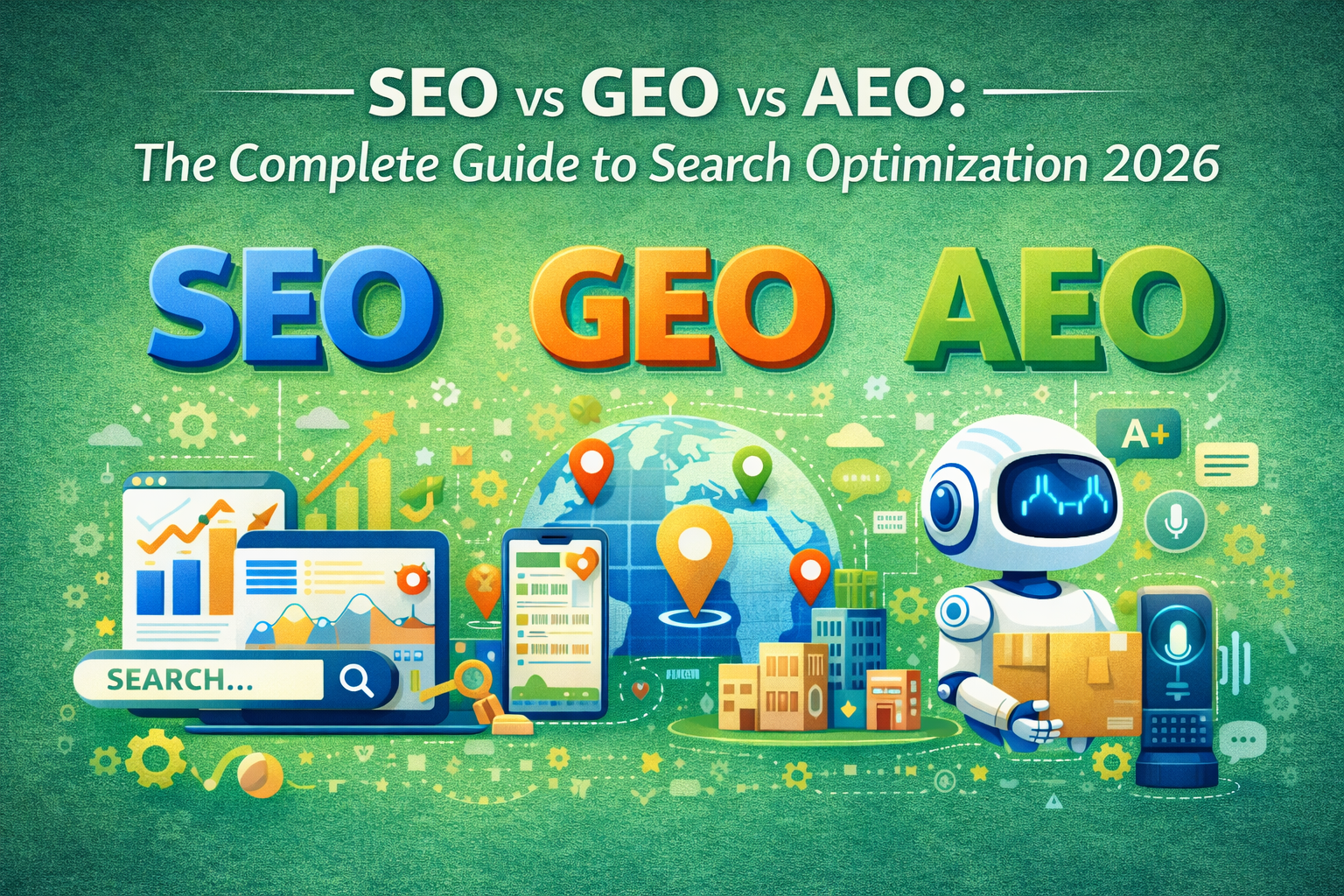
Getting found online used to mean one thing: ranking on Google. Not anymore. As AI assistants and answer boxes reshape how people search, three optimization disciplines now matter — traditional SEO, Generative Engine Optimization (GEO), and Answer Engine Optimization (AEO). This guide breaks down what each one is, how they differ, and how to build a single content strategy that wins across all three so your content gets found wherever people look.
Key Takeaways
- SEO ranks your pages in traditional search results (Google, Bing).
- GEO gets your content cited by AI engines like ChatGPT, Claude, Perplexity, and Google AI Overviews.
- AEO captures featured snippets and direct answer boxes (“position zero”).
- A combined strategy across all three delivers the best visibility.
- Content quality, authority, and user intent remain central to all three.
What is SEO? (Search Engine Optimization)
SEO is the practice of optimizing your website and content to rank higher in organic search results on engines like Google and Bing — the foundational discipline for driving organic traffic.
Search engines crawl, index, and rank pages based on relevance, authority, and user experience. SEO works across three pillars: on-page (keywords, titles, headers, internal links, content quality), off-page (backlinks, brand mentions, reputation), and technical (site speed, mobile-friendliness, sitemaps, structured data, SSL). Success is measured through organic traffic, keyword rankings, click-through rate, and conversions — tracked with tools like Google Analytics, Search Console, and platforms such as Semrush.
What is GEO? (Generative Engine Optimization)
GEO is the practice of optimizing content to be cited, referenced, and featured by AI-powered generative engines like ChatGPT, Claude, Perplexity, and Google’s AI Overviews.
Unlike search engines that send users to websites, generative engines synthesize information from many sources and present a direct answer. To be the source AI pulls from, your content needs four things: contextual clarity (a direct answer in the first ~150 words), organization (clean structure and schema AI can parse), referenceability (clear citations, statistics, authoritative sources), and exclusivity (unique insights or original data found nowhere else).
In practice, that means writing quotable, definitive statements, including original data and research, establishing author expertise, using FAQ structures, and keeping facts specific and verifiable rather than vague.
What is AEO? (Answer Engine Optimization)
AEO is the practice of optimizing content to appear in featured snippets, knowledge panels, and “People Also Ask” boxes — earning “position zero” above the regular results.
AEO bridges traditional SEO and the AI-driven landscape. It targets the direct-answer formats that sit at the very top of results: paragraph snippets, list snippets, table snippets, knowledge panels, and PAA boxes. Winning them requires question-based content, concise 40–60-word answers, FAQ and HowTo schema markup, clean lists and tables, and question-based headers that match how people actually search. A tool like Frase helps by structuring content around the exact questions ranking pages already answer.
SEO vs GEO vs AEO: Full Comparison
| Aspect | SEO | GEO | AEO |
|---|---|---|---|
| Primary target | Search results (SERPs) | AI generative engines | Snippets & answer boxes |
| Main goal | Drive organic traffic | Get cited by AI | Capture position zero |
| Content format | Long-form, comprehensive | Quotable, fact-dense | Concise, direct answers |
| Success metric | Rankings, traffic, conversions | AI citations, mentions | Snippets, visibility |
| Keyword focus | Broad keywords | Question-based, conversational | Specific question queries |
| Content length | 1,500–3,000+ words | Variable, density-focused | 40–60-word answers |
| Authority signals | Backlinks, domain authority | Citations, expert credentials | Accuracy, source reliability |
| Time to results | 3–6 months | Emerging, variable | 2–4 weeks |
| Competition | High | Lower (emerging) | Moderate |
Key Differences Between SEO, GEO & AEO
Traffic vs. Visibility
SEO is about driving clicks to your site. GEO may not drive direct traffic — when AI cites you, users often get their answer without visiting — so its value is brand visibility, authority, and indirect traffic. AEO sits between: snippets provide visibility and often still earn clicks from users wanting the full picture.
Content Structure
SEO rewards comprehensive, in-depth pages. GEO rewards machine-parseable content — clear definitions, quotable statements, explicit facts AI can extract. AEO rewards a specific format: a direct answer in the first paragraph under a question-based heading, formatted for snippet extraction.
Authority Signals
SEO weights backlinks and domain authority. GEO emphasizes author expertise, original research, and verifiable credentials. AEO focuses on accuracy, clear sourcing, and alignment with established knowledge.
How to Build an Integrated Strategy
You don’t choose one — the smart play is content that wins on all three at once. Here’s the process:
Step 1: Audit Your Content
Assess existing pages against all three frameworks. Find pages that rank traditionally but lack schema, quotable statements, or snippet-ready formatting.
Step 2: Build Topic Clusters with Multiple Intents
- Pillar content — comprehensive guides optimized for SEO with strong keyword targeting
- Supporting content — FAQ pages and direct-answer content for AEO
- Authority content — original research and data-driven pieces for GEO
Step 3: Get the Technical Foundations Right
Fast, mobile-responsive pages for SEO; comprehensive schema markup for GEO and AEO; clear architecture for crawlability; and proper header hierarchy throughout.
Step 4: Create Multi-Format Content
Lead each piece with a direct 40–60-word answer (AEO), expand into comprehensive coverage (SEO), weave in quotable facts, stats, and expert insight (GEO), and add tables and lists for enhanced visibility.
Step 5: Monitor & Iterate
Track traditional rankings and traffic (SEO), AI citations and mentions (GEO), and snippet acquisitions (AEO). Refine continuously.
The efficient move: Structure every post as an AEO-friendly answer up top, wrapped in
SEO-depth below, seasoned with GEO-friendly facts and sources. One well-built article can win all three at once.
The Future of Search Optimization
The lines between SEO, GEO, and AEO are blurring as search engines fold AI-generated answers directly into results. Zero-click searches — where users get answers without visiting a site — mean you must balance traffic generation with brand visibility, treating an AI citation or snippet as valuable even without the click. Through all of it, one thing stays constant: quality wins. Search engines, AI systems, and snippet algorithms all favor content that shows expertise, provides genuine value, and satisfies intent.
Frequently Asked Questions
What’s the difference between SEO, GEO, and AEO?
SEO ranks your pages in search results, GEO gets your content cited by AI engines like ChatGPT, and AEO captures featured snippets and answer boxes. They overlap but target different destinations.
Is GEO replacing SEO?
No — it’s adding to it. SEO still drives most organic traffic, but as AI answers grow, GEO ensures you’re the source those answers cite. The winning approach combines both rather than choosing.
Do I need to do all three?
Ideally yes, but you can do it efficiently. A single well-structured article — direct answer up top, comprehensive body, quotable facts and schema — can satisfy SEO, GEO, and AEO at the same time.
Which is easiest to rank for right now?
GEO and AEO face less competition because they’re newer — many sites haven’t optimized for them yet. Getting in early gives you an advantage while competitors catch up.
What tools help with GEO and AEO?
Traditional SEO tools like Semrush still apply, and content-optimization tools like Frase help structure question-based, snippet-ready content. Schema markup plugins handle the technical side for AEO.
Bringing It Together
The 2026 search landscape rewards content that satisfies both humans and the AI systems increasingly mediating how people find information. Start by auditing your existing content, then build pieces that answer directly (AEO), cover thoroughly (SEO), and cite authoritatively (GEO). To execute, you’ll want the right tools — see our SEO tool comparison (Semrush vs Ahrefs vs Moz) and the complete digital marketing tech stack.
Put this into practice
Grab our SEO, GEO & AEO content checklists and optimization templates from the shop — everything you need to make every post rank across all three.
Browse the Template Shop →