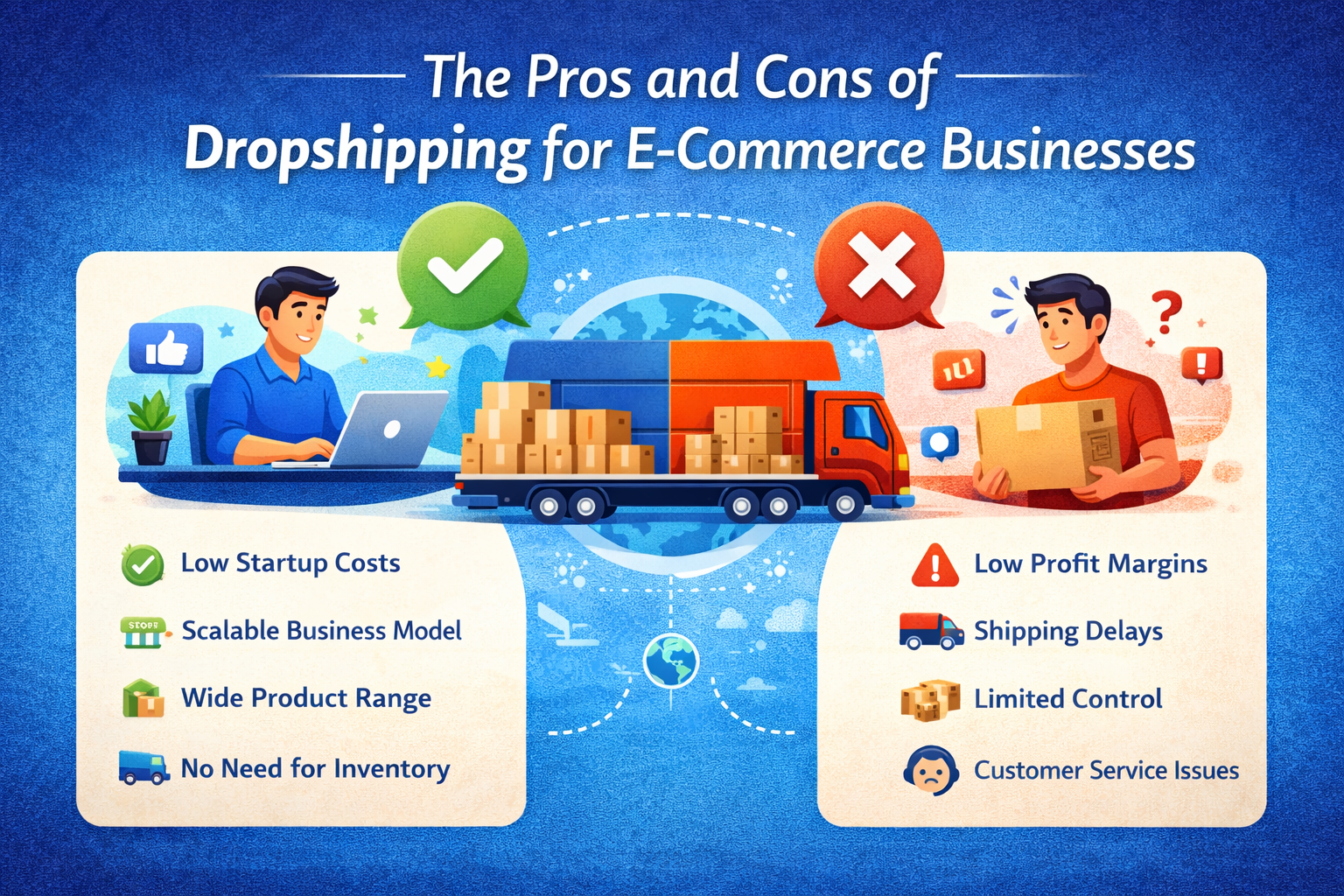
The Pros and Cons of Dropshipping for E-Commerce Businesses
The honest pros and cons of dropshipping in 2026 — low startup costs and low risk vs thin margins and high competition. See who it works for and how to succeed.

Disclosure: This post contains affiliate links. If you sign up through them, we may earn a
commission at no extra cost to you. We only recommend tools we believe help sellers succeed.
Read our full Affiliate & Earnings Disclaimer.
Dropshipping is one of the most talked-about ways to start an online business — no inventory, low startup cost, and the freedom to sell from anywhere. But behind the “get rich quick” hype lies a real business model with genuine trade-offs: thin margins, fierce competition, and less control over quality and shipping. So is it right for you? This honest guide breaks down the real pros and cons of dropshipping in 2026, who it works for, who should avoid it, and how to give yourself the best shot at success.
Quick Verdict
Dropshipping is a low-risk way to start and test an e-commerce business, but a hard way to build a high-margin one. It’s excellent for validating products and learning the ropes with little money down — but long-term success requires strong marketing, a real brand, and reliable suppliers. Treat it as a starting point, not a shortcut.
Related reading: See our
best e-commerce tools for sellers and the
ultimate guide to e-commerce SEO to build your store the right way.
What Is Dropshipping?
Dropshipping is a retail fulfillment model where you sell products without holding inventory. When a customer orders from your store, you forward the order to a third-party supplier, who ships the product directly to the customer. You never touch the product — your job is marketing, customer service, and running the storefront, while the supplier handles storage, packing, and shipping. Your profit is the margin between what the customer pays and what the supplier charges you.
The Pros of Dropshipping
✓ Advantages
- Low startup costs — no inventory to buy upfront, so you can launch for the price of a domain and a store subscription.
- Low risk — you only pay for products after you’ve been paid by the customer.
- Location freedom — run it from anywhere with a laptop and internet.
- Easy to test products — add or drop products instantly without being stuck with unsold stock.
- Wide product selection — offer thousands of products without warehousing any of them.
- Scalable — order volume doesn’t require you to pack more boxes yourself.
The headline benefit is low barrier to entry. Traditional retail demands buying inventory before you sell a single unit; dropshipping flips that, letting you validate whether a product sells before spending on stock. That makes it one of the safest ways to learn e-commerce and test ideas cheaply.
The Cons of Dropshipping
✗ Disadvantages
- Low profit margins — you pay more per unit than bulk buyers, so margins are thin (often 10–30%).
- High competition — low barriers mean many sellers offer identical products, driving prices down.
- Less control over quality — you can’t inspect products before they reach customers.
- Shipping complexity — long delivery times, especially from overseas suppliers, hurt satisfaction.
- Inventory blind spots — a supplier can run out of stock without warning.
- Customer service burden — you own every complaint even when the supplier caused the problem.
- Brand-building is harder — generic products make differentiation and loyalty difficult.
The core challenge is that thin margins meet high competition. Because anyone can sell the same supplier’s products, price wars are common and margins get squeezed — which means your marketing has to be excellent just to stay profitable. And since you don’t control fulfillment, quality and shipping problems land on you.
Reality check: Dropshipping isn’t passive income. Success takes real work in marketing, customer service, and supplier management — the sellers who treat it like a serious business are the ones who profit.
Dropshipping vs Traditional E-Commerce
| Factor | Dropshipping | Traditional Retail |
|---|---|---|
| Startup cost | Low | High (buy inventory) |
| Profit margins | Low (10–30%) | Higher (bulk pricing) |
| Inventory risk | None | High (unsold stock) |
| Quality control | Limited | Full |
| Shipping control | Supplier-dependent | Full control |
| Branding potential | Harder | Stronger |
| Scalability | Easy | Requires capital |
Who Should (and Shouldn’t) Dropship
Dropshipping is a good fit if you:
- Are starting with limited capital and want to minimize risk
- Want to test product ideas before committing to inventory
- Are strong at marketing, ads, or building an audience
- Value flexibility and want a location-independent business
It’s probably not for you if you:
- Want high profit margins from day one
- Need full control over product quality and shipping speed
- Aren’t prepared to invest heavily in marketing
- Want a truly hands-off, passive income stream
How to Succeed at Dropshipping
The sellers who make dropshipping work do a few things differently. Follow these to tilt the odds in your favor:
- Choose a niche — don’t sell everything; a focused niche lets you build a brand and reduce competition.
- Vet suppliers carefully — reliable suppliers with good shipping times and quality are non-negotiable; order samples first.
- Build a real brand — custom store, unique descriptions, and consistent visuals (use Canva) separate you from generic sellers.
- Master marketing — this is where dropshipping is won; invest in SEO (Semrush) and paid ads.
- Capture emails — use Klaviyo to turn one-time buyers into repeat customers and improve margins.
- Deliver great support — fast, helpful service (Gorgias) offsets the quality/shipping risks you don’t control.
- Collect reviews — social proof (Judge.me) builds the trust generic products lack.
Most dropshipping stores are built on Shopify, which connects easily to supplier apps and gives you the storefront, payments, and integrations to run the whole operation.
Frequently Asked Questions
Is dropshipping still profitable in 2026?
Yes, but it’s competitive. Profit comes from strong marketing, a real brand, good supplier relationships, and a focused niche — not from simply reselling generic products. Treated as a serious business, it can be profitable.
How much does it cost to start dropshipping?
You can start for around $50–$150/month — mainly a store platform like Shopify plus a domain. You don’t buy inventory upfront, which is the model’s biggest advantage. Budget for marketing on top of that.
What are the biggest risks of dropshipping?
Thin margins, high competition, and lack of control over quality and shipping. Long delivery times and supplier stockouts can hurt customer satisfaction — which lands on you, not the supplier.
Is dropshipping passive income?
No. It requires ongoing work in marketing, customer service, and supplier management. It’s flexible and location-independent, but it’s an active business, not passive income.
Dropshipping or holding inventory — which is better?
Dropshipping is better for starting cheap and testing products; holding inventory offers higher margins and full control. Many sellers start with dropshipping to validate, then move winning products to inventory.
The Bottom Line
Dropshipping is a genuinely smart way to start — low risk, low cost, and a fast way to learn e-commerce and test products. But it’s not a shortcut to easy money: thin margins and heavy competition mean your marketing, brand, and supplier choices decide whether you profit. If you go in with realistic expectations and treat it as a real business, it can be a powerful launchpad. Start on Shopify, pick a focused niche, vet your suppliers, and pour your energy into marketing — that’s the formula that works.
Thinking of starting a store?
Grab our dropshipping starter kit — supplier vetting checklists, niche-research templates, and store-launch frameworks — from the shop, and start on the right foot.
Browse the Template Shop →