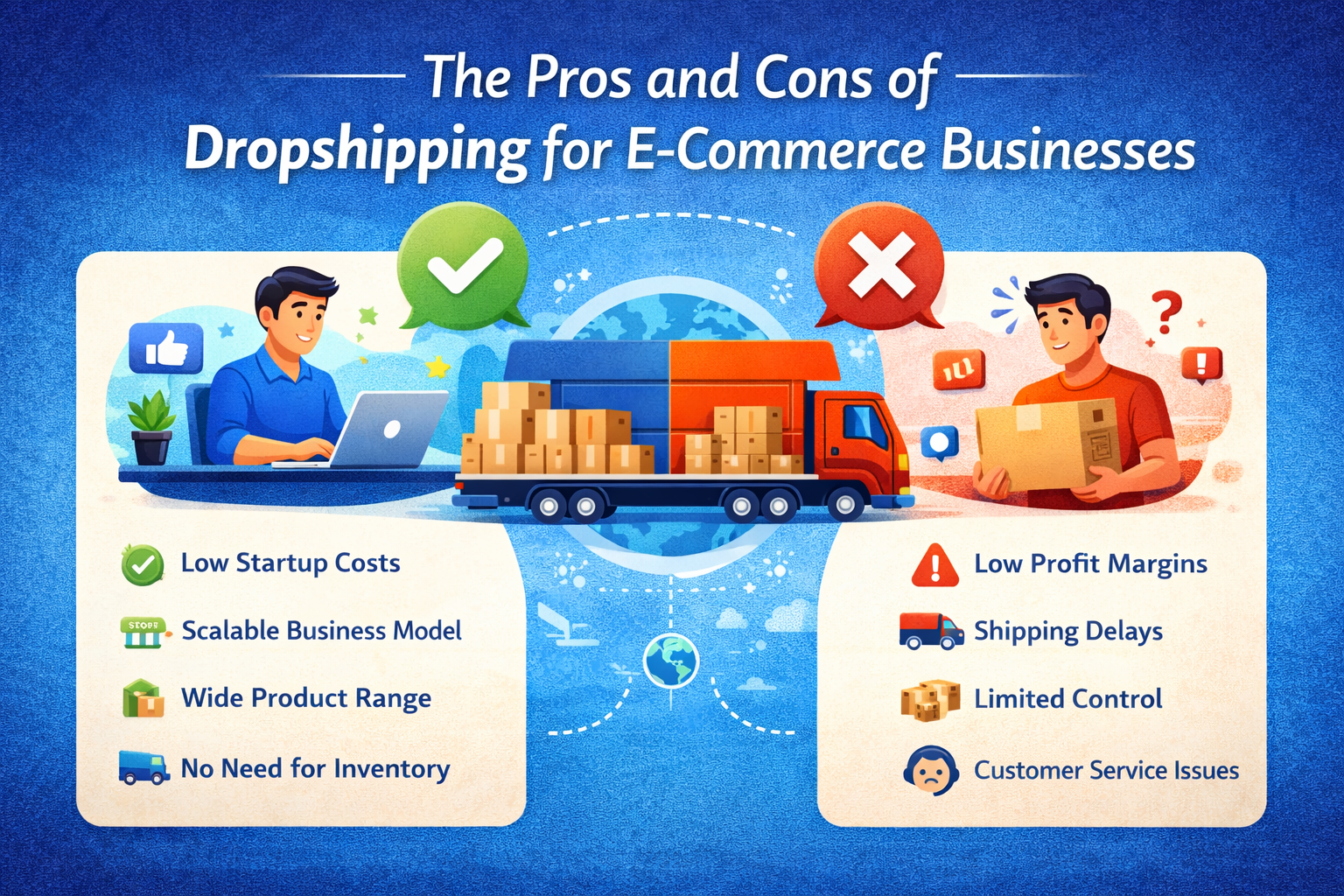
The Pros and Cons of Dropshipping for E-Commerce Businesses

Dropshipping has become one of the most talked-about business models in the e-commerce world — and for good reason. It promises low startup costs, no inventory headaches, and the freedom to run a business from anywhere. But is it really as easy as the YouTube gurus make it sound?
The truth is, dropshipping has real advantages and real drawbacks. Understanding both sides before you dive in can save you months of frustration and thousands of dollars. This guide gives you an honest, balanced look at the pros and cons of dropshipping so you can decide if it’s the right e-commerce business model for you.
What Is Dropshipping and How Does It Work
Dropshipping is a retail fulfillment method where you sell products online without ever holding inventory. Here’s how the process works:
- You set up an online store and list products for sale
- A customer places an order and pays you
- You forward the order to your supplier
- The supplier packages and ships the product directly to your customer
- You keep the difference between what the customer paid and what the supplier charged you
You never touch the product. You never rent a warehouse. Your job is to run the storefront, attract customers, and manage relationships with suppliers.
This model became widely popular thanks to platforms like Shopify, AliExpress, and tools like DSers and Zendrop, which make it easier than ever to launch a dropshipping store in a matter of days.
How Dropshipping Differs from Traditional E-Commerce
Understanding what makes dropshipping unique helps clarify both its appeal and its limitations. Here’s how it stacks up against traditional e-commerce:
- Traditional e-commerce requires you to purchase inventory upfront, store it, pack it, and ship it yourself — or pay a fulfillment center like Amazon FBA to do it
- Dropshipping eliminates all of that — you only pay for a product after a customer has already bought it from you
The trade-off is clear: dropshipping removes financial risk and logistical complexity but gives you less control over product quality, packaging, and shipping speed. Traditional e-commerce demands more upfront investment but offers higher margins and a stronger brand experience.
Neither model is universally better. The right choice depends on your budget, goals, and tolerance for risk.
The Pros of Dropshipping
Let’s start with what makes dropshipping so attractive, especially for new entrepreneurs entering the e-commerce space.
Low Startup Costs and No Inventory Risk
Perhaps the biggest advantage of dropshipping is how little money you need to get started. With a traditional retail business, you might need thousands of dollars to purchase stock before making a single sale. With dropshipping, you only pay for products after your customers have already paid you.
This means:
- No upfront inventory investment
- No risk of being stuck with unsold stock
- No warehousing or storage fees
- Minimal financial exposure when testing new products
For entrepreneurs with limited capital, this is a game-changer. You can launch a professional-looking online store for as little as the cost of a Shopify subscription and a domain name.
Easy to Launch and Scale Quickly
Setting up a dropshipping business is significantly faster than building a traditional e-commerce operation. You don’t need to source, photograph, or warehouse products. Suppliers often provide ready-made product images and descriptions you can use immediately.
Scaling is also more straightforward. When sales increase in a traditional store, you need to hire more staff, order more stock, and expand storage. With dropshipping, your supplier handles fulfillment regardless of whether you’re processing 10 orders or 1,000 orders per day. Your main scaling challenge is simply driving more traffic and managing customer service.
Wide Product Selection Without Warehousing
Because you’re not pre-purchasing inventory, you can offer a much wider range of products in your store. You can list hundreds or even thousands of items across multiple categories without any additional financial risk.
This flexibility also makes it easy to test new products. Want to see if a trending gadget sells well? Add it to your store, run a small ad campaign, and see what happens — with zero upfront investment. If it doesn’t sell, simply remove it. This kind of low-risk product testing is nearly impossible with traditional inventory models.
Location and Time Freedom
Dropshipping is one of the most location-independent business models available. As long as you have a laptop and an internet connection, you can manage your store from anywhere in the world. This makes it particularly popular among digital nomads, remote workers, and anyone looking to build an income stream that isn’t tied to a physical location.
You also have flexibility over your schedule. While running a successful dropshipping business still requires real work and attention, you’re not tied to warehouse hours, shipping deadlines, or stock management duties.
The Cons of Dropshipping
Now for the side of dropshipping that doesn’t always make it into the highlight reels. These are real challenges that every dropshipper faces — and understanding them upfront will help you plan better.
Lower Profit Margins
Because dropshipping removes inventory risk, suppliers charge higher per-unit prices than they would for bulk orders. This compresses your profit margins significantly. While a traditional retailer might buy a product for $5 and sell it for $30, a dropshipper might pay $18 for the same item and struggle to sell it competitively above $25.
When you factor in advertising costs — which are almost always necessary to drive traffic — many dropshippers find themselves earning very thin margins per sale. Scaling volume becomes essential to generate meaningful income, which brings its own challenges.
High Competition and Market Saturation
Dropshipping’s low barrier to entry is both its strength and its weakness. Because anyone can start a dropshipping store with minimal investment, popular niches become saturated very quickly. You may find yourself competing against dozens of other stores selling the exact same products from the same suppliers — sometimes at lower prices than you can profitably match.
Standing out in a crowded market requires strong branding, excellent marketing, and ideally a unique angle or niche. Generic “general stores” selling trending products have become increasingly difficult to sustain profitably as competition has intensified over the years.
Limited Control Over Shipping and Quality
This is one of the most frustrating aspects of dropshipping. Since you never handle the product yourself, you’re entirely dependent on your supplier for:
- Product quality — You can’t inspect items before they reach your customers
- Packaging — Many dropshipping suppliers use plain or branded packaging that doesn’t reflect your brand
- Shipping times — Especially with suppliers based overseas, delivery times can stretch to 2–4 weeks, leading to customer complaints
- Stock availability — A product can go out of stock with little warning, leaving you with orders you can’t fulfill
Any of these issues can lead to negative reviews, refund requests, and damage to your brand reputation — even though the problem was entirely out of your hands.
Supplier Dependency and Stock Issues
Your entire business depends on your suppliers performing reliably. If a supplier runs out of stock, raises their prices, discontinues a product, or simply provides poor service, your business suffers directly.
Many dropshippers learn the hard way to always have backup suppliers for their best-selling products. Building relationships with multiple reliable suppliers — and vetting them carefully before scaling — is one of the most important risk management strategies in dropshipping.
Is Dropshipping Still Worth It in 2026?
This is the question everyone asks, and the honest answer is: yes, but with realistic expectations.
Dropshipping is not the “passive income while you sleep” fantasy that some influencers portray. It is a real business that requires real work, smart marketing, and genuine customer service. The entrepreneurs who succeed with dropshipping in 2026 share a few common traits:
- They focus on specific niches rather than general stores
- They build a real brand with custom packaging and strong customer communication
- They use domestic or faster suppliers to compete on delivery speed
- They invest in learning paid advertising or SEO to drive consistent traffic
- They treat it as a long-term business, not a get-rich-quick scheme
The dropshipping market is more competitive than it was five years ago, but it is far from dead. Sellers who approach it strategically and commit to building a real brand are still finding significant success.
Tips for Running a Successful Dropshipping Business
If you decide dropshipping is right for you, here are the most important tips to maximize your chances of success:
- Choose a focused niche — A store specializing in pet accessories for small dogs will always outperform a generic “everything” store
- Vet your suppliers thoroughly — Order test products before listing them. Check reviews, shipping times, and communication responsiveness
- Prioritize customer service — Fast, friendly responses to inquiries and complaints will set you apart from the majority of dropshippers who ignore customers
- Build your brand — Use a professional logo, consistent colors, and a compelling brand story to create a memorable shopping experience
- Invest in SEO — Building organic traffic through product page SEO and a blog reduces your dependence on paid ads over time
- Use quality product photos and descriptions — Don’t just copy-paste supplier content. Rewrite descriptions and use high-quality images to build trust
- Track your numbers — Monitor your cost per acquisition, average order value, and return rate carefully to ensure you’re actually profitable
Dropshipping vs Other E-Commerce Models — Which Is Right for You?
Not sure if dropshipping is the best fit? Here’s a quick comparison of the most popular e-commerce business models to help you decide:
| Model | Startup Cost | Profit Margin | Control | Best For |
|---|---|---|---|---|
| Dropshipping | Very Low | Low–Medium | Low | Beginners, testing niches |
| Print on Demand | Very Low | Low–Medium | Medium | Creative entrepreneurs |
| Private Label | Medium–High | High | High | Brand builders |
| Wholesale/Retail | High | Medium–High | High | Established sellers |
| Amazon FBA | Medium | Medium–High | Medium | Scaling with fulfillment support |
Each model has its place depending on your budget, goals, and how hands-on you want to be. Many successful e-commerce entrepreneurs start with dropshipping to learn the fundamentals, then transition to private label or wholesale once they’ve found a winning niche and built a customer base.
Final Thoughts and Next Steps
Dropshipping is a legitimate e-commerce business model — but it works best for those who go in with clear eyes, a solid strategy, and a commitment to building something real. The low barrier to entry makes it accessible to almost anyone, but that same accessibility means you need to work harder to differentiate yourself.
If you’re just getting started in e-commerce, dropshipping is still one of the best ways to learn the ropes without putting significant capital at risk. Use it as a learning platform, build your marketing skills, find your niche, and reinvest your profits into a more sustainable model as you grow.
Ready to take the next step? Explore our full library of ecommerce seller resources, AI tools, and digital marketing guides at DigiNomad818.com — everything you need to build and grow your online business smarter. 🚀