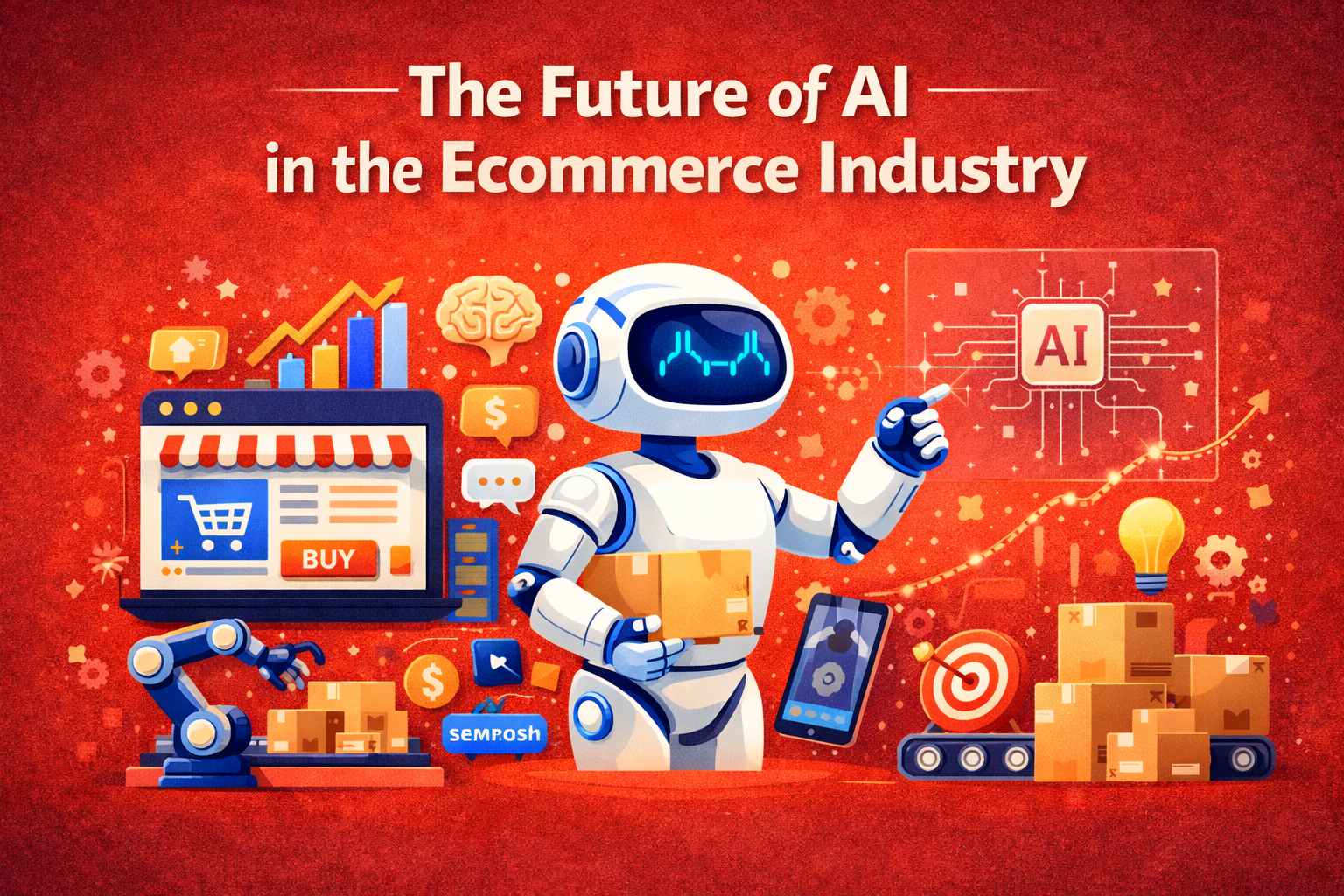
The Future of AI in the Ecommerce Industry: Trends, Predictions, and Strategies for 2026

Meta Description: Explore the transformative future of AI in ecommerce for 2025-2026. Discover how Agentic AI, hyper-personalization, and generative search are reshaping online retail. Learn strategies to stay ahead and understand the future of ai.
The ecommerce landscape is undergoing a seismic shift. As we move through 2025 and into 2026, Artificial Intelligence (AI) is no longer just a competitive advantage—it is the fundamental infrastructure upon which modern retail is built. From the early days of basic product recommendations, we have graduated to an era of Agentic AI, hyper-personalized shopping experiences, and autonomous supply chains.
For online retailers, understanding these shifts is not optional. The market is evolving rapidly, with the global AI in ecommerce market projected to reach staggeringly high valuations by the end of the decade. This guide explores the defining trends of AI in the ecommerce industry for 2026, offering actionable insights for businesses ready to future-proof their operations.
As we navigate the complexities ahead, staying informed about the future of ai will be crucial for success.
The Evolution of AI in Ecommerce: From Tools to Agents
To understand the future, we must recognize the transition we are currently witnessing. In the early 2020s, AI was a tool used by humans to analyze data or generate content. In 2026, AI is becoming an agent—an autonomous entity capable of making decisions and executing tasks, shaping the narrative of the future of ai.
1. The Rise of Agentic AI
The buzzword for 2026 is Agentic AI. Unlike traditional chatbots or recommendation engines that respond to prompts, AI agents can proactively achieve goals.
- For Consumers: Imagine a personal shopping assistant that doesn’t just suggest a pair of running shoes but finds the best price across the web, verifies the return policy, checks reviews for sizing accuracy, and even initiates the checkout process—all based on a simple command like “Find me durable trail running shoes under $150.”
- For Retailers: Agentic AI means autonomous customer service systems that can handle complex refunds, negotiate shipping times with logistics providers, and reorder inventory when stock levels dip, without human intervention.
Strategic Insight: Retailers must optimize their stores not just for human eyes, but for AI agents. This means structured data is more critical than ever. If an AI agent cannot “read” your product specs, shipping policies, and inventory levels via API or structured markup, your products effectively become invisible to the highest-intent buyers.
2. Hyper-Personalization at Scale
Personalization has been a goal for years, but AI is finally delivering on the promise of “segment of one.”
- Real-Time Adaptation: In 2026, static storefronts are obsolete. AI algorithms analyze hundreds of data points—from current weather in the user’s location to their mouse movement speed—to dynamically adjust the homepage layout, pricing, and product sorting in milliseconds.
- Predictive Shopping: AI models are now accurate enough to predict what a customer needs before they search for it. Subscription services are evolving into “anticipatory shipping” models, where brands send products they are 90% sure a customer wants, with a frictionless return process for the 10% they miss.
3. Generative AI for Content and Visuals
Generative AI (GenAI) has matured from a production novelty to a powerhouse.
- Dynamic Product Imagery: Instead of costly photoshoots, brands are using GenAI to generate product images on the fly. A customer browsing for furniture can upload a photo of their living room, and the ecommerce site will render the sofa in their actual space, matching the lighting and perspective perfectly.
- Multilingual and Localized Content: GenAI creates culturally nuanced product descriptions for global markets instantly. It doesn’t just translate; it transcreates, adjusting idioms, references, and tone to fit the local market, breaking down cross-border commerce barriers.
Operational Efficiency: The Hidden AI Revolution
While customer-facing AI gets the glory, the back-end revolution is where margins are made.
4. Smart Supply Chain and Inventory Management
The “Bullwhip Effect” in supply chains is being tamed by AI.
- Demand Forecasting: Advanced models analyze global events, social media trends, and economic indicators to predict demand surges with uncanny accuracy. If a specific fashion style trends on TikTok in the morning, AI-driven supply chains can adjust manufacturing orders by the afternoon.
- Last-Mile Optimization: Autonomous delivery vehicles and drones are becoming more common in urban centers, routed by AI to minimize fuel consumption and delivery time.
5. Dynamic Pricing 2.0
Pricing strategies are becoming fluid. AI analyzes competitor pricing, demand elasticity, and inventory expiry dates in real-time.
- Personalized Pricing: (Controversial but emerging) offering discounts not just based on inventory, but on a customer’s loyalty score or probability of churn.
- Profit Optimization: Instead of a race to the bottom, AI helps retailers find the “sweet spot” price that maximizes total profit rather than just conversion rate.
SEO in the Age of AI: Optimizing for AIO and GEO
Search Engine Optimization (SEO) is transforming into Generative Engine Optimization (GEO) and AI Optimization (AIO).
The Shift from Keywords to Context
With the dominance of AI-powered search (like Google’s AI Overviews and ChatGPT Search), users are asking complex, conversational questions.
- Long-Tail Intent: SEO strategies must focus on answering specific, multi-layered questions (e.g., “What is the best ergonomic chair for a tall person with back pain under $300?”).
- Authority and Experience: Search AIs prioritize content that demonstrates deep expertise (E-E-A-T). Generic, mass-produced content is being devalued.
- Video and Visual Search: Visual SEO is critical. As users search with images (“Where can I buy this shirt?”), having high-quality, clearly labeled visual assets is mandatory.
Challenges and Ethical Considerations
The future is bright, but not without shadows.
- Data Privacy and Trust: As AI becomes more predictive, the “creepiness factor” increases. Brands must balance personalization with privacy, ensuring transparent data usage (Digital Product Passports can help here by providing transparency).
- Algorithm Bias: Retailers must audit their AI tools to ensure they don’t inadvertently discriminate in pricing or ad targeting based on demographics.
- Dependence Risks: Over-reliance on automated systems can lead to fragility. If the AI hallucinates or the API fails, businesses need human fallback protocols.
FAQ: AI in Ecommerce
Q: Will AI replace human customer support agents?
A: AI is replacing tier-one support (answering FAQs, tracking orders). However, it is elevating human agents to handle complex, emotional, or high-value interactions that require empathy and judgment.
Q: Is AI only for large enterprise retailers?
A: No. Tools like Shopify Magic and various plugins have democratized AI. Small businesses can now use AI for email marketing, product descriptions, and basic chatbots at a fraction of the cost of enterprise custom solutions.
Q: How do I prepare my ecommerce site for AI search agents?
A: Focus on structured data (Schema markup). Ensure your product data (price, availability, specs) is machine-readable. Create detailed, authoritative content that answers complex user questions directly.
Q: What is the biggest risk of ignoring AI in ecommerce?
A: Irrelevance. Competitors using AI will have lower operating costs, better conversion rates, and superior customer retention. Ignoring AI in 2026 is akin to ignoring the internet in 2000.
Conclusion
The future of AI in the ecommerce industry is not about robots taking over; it’s about frictionless commerce. By 2026, the lines between discovery, decision, and transaction will blur. Agentic AI will act as the ultimate concierge, while back-end algorithms ensure the right product is at the right place at the right time.
For business owners, the message is clear: Start building your AI infrastructure now. Audit your data quality, experiment with agentic tools, and focus relentlessly on adding value that AI cannot replicate—brand story, community, and human connection. The future of ecommerce is intelligent, autonomous, and incredibly exciting.